

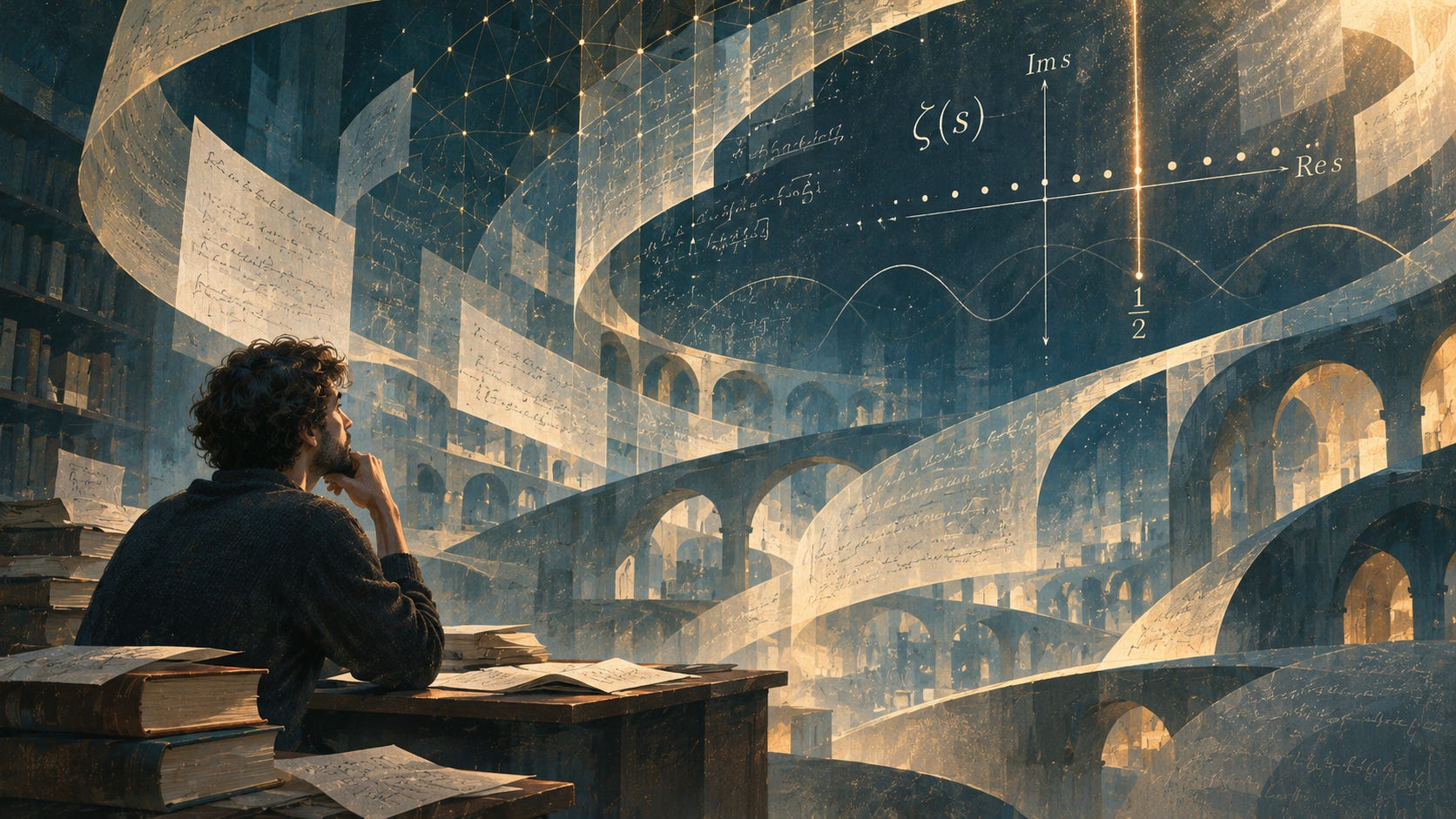
Who today can actually say they know that the Riemann hypothesis is true? The answer is surprisingly complicated. On 20 November, the mathematician Levent Alpöge, working with the AI system Claude, published a proof of one of mathematics’ most famous unsolved problems. Seventeen million lines of formal code passed independent computer checks, and the next day the Lean and Mathlib communities confirmed the validity of the formal proof. The model also produced an explanation that would run to more than 250,000 pages — far more than anyone is likely to read. Alpöge admits that the machine outpaced him near the end and that he does not yet fully understand the proof.
Knowledge without a knower
So far the discussion has revolved mainly around two questions: whether the proof is correct, and who deserves the credit for it. A third question is more interesting: what has happened to knowledge itself? We usually think of knowledge as something a person has in their head or something written down somewhere. To know something is, in principle, to be able to explain, defend and use it. Science extended this idea to the scientific community. No individual knows everything, but someone in the community can usually check a result, put it in context and pass it on to the next generation.
Science, then, is not a library of results. It is a collective enterprise that creates, verifies, explains and transmits knowledge while training the next generation of researchers. Like other institutions, science has its own economy of recognition. It shapes who receives recognition, academic positions and research funding — and, indirectly, which questions are investigated at all.
Computer-assisted proofs are nothing new. Decades ago, mathematicians were already accepting theorems whose verification had been partly left to computers. But something more important is changing now. Machines now do more than check proofs: they increasingly find them on their own, and at remarkable speed. For the first time on this scale, we are confronting formally verified results that the mathematical community cannot yet fully explain.
Mathematics is the first discipline in which artificial intelligence is so profoundly changing the relationship between producing results and understanding them. That is why it is worth looking closely at what is happening there. It offers a preview of changes that the rest of science may soon face.
The peacock’s tail of mathematics
A mathematical proof has always served two purposes that, for a long time, seemed inseparable. The first is logical: a proof guarantees that a statement follows from accepted assumptions. The second is social, but no less important. A proof was evidence that someone had accomplished difficult intellectual work. Anyone who proved a difficult conjecture generally needed a deep command of the field, an original idea or an unexpected connection between previously separate theories.
In evolutionary biology, a signal can be credible precisely because it is costly. A peacock’s extravagant tail takes energy to maintain and makes movement more difficult. Precisely because it is costly, it can signal something about the male’s quality to potential mates. A demanding proof was mathematics’ version of the peacock’s tail. Because it was hard to produce, it was a fairly reliable sign of research ability. No one can look inside another person’s head and measure how much they understand, but one can judge the results of their work. And if a new proof could be reached only with a great deal of knowledge, ingenuity and persistence, the achievement also said something about its author.
Mathematics had a rare advantage here. What could be counted and listed on a CV was closely related to what the community needed: the ability to solve problems, develop new ideas and train researchers. The connection was never perfect. Mathematics, too, had technically demanding but insignificant results, and great ideas that could not easily be credited to a single author. Yet as long as proving things was hard, a new proof still said something important about the abilities of the person who found it. With artificial intelligence, that connection can no longer be taken for granted.
Why did this happen in mathematics first? Artificial intelligence advances fastest where the correctness of an answer can be checked quickly and reliably. In chess we know who won; with computer code we can test whether it works. A formal mathematical proof offers an even stricter standard: a computer can check every logical step without needing to understand why a particular idea was used. Mathematicians also have a vast literature, ever richer libraries of formalised results and long lists of problems they still cannot solve. Machines thus had the raw material, a clear measure of success and a list of targets.
The inflation of proofs
When too much money is printed, its value falls. Something similar is happening to mathematical proofs. Once machines can produce them in large quantities and at unprecedented speed, each individual proof loses value as a research achievement.
Within a few months, companies published hundreds of solutions to open problems, with one company releasing several hundred papers in a single day. Some of the results are groundbreaking; others are long and almost unreadable. Some open up new fields; others settle obscure questions whose wider significance remains unclear. A mathematical community accustomed to major advances emerging from years of work suddenly faces a flood of results, with no guarantee that anyone will read them carefully.
The first thing to be unsettled was the question of credit. The company that published a mass of solutions presented them as raw mathematical data and waived the usual claim to authorship. But then who deserves the credit? The developers of the model, the researchers who chose the problems, or the mathematicians whose earlier work made the solutions possible? The proof of the Riemann hypothesis has a human co-author who does not yet fully understand its derivation.
On the same day, the mathematician Alessandro Masullo prematurely released an extensive draft of a different, entirely human proof, on which he had worked for almost twelve years. Its correctness has yet to be checked. The mathematical community was thus confronted with two almost opposite problems: a machine proof whose formal correctness can be verified without human understanding, and a human manuscript that offers an argument whose correctness has yet to be established.
The race for priority, which has driven science for centuries, is acquiring entirely new rules. If a model can solve in a few hours a problem on which a researcher has worked for years, the date of publication is no longer a particularly reliable measure of scientific contribution.
Scientific institutions are no better prepared for this volume of new results. Reviewers were already in short supply; now they face a flood of texts that look convincing at first glance. Until now, the plan of a research project in a grant application was a promise that a group would achieve something within a few years. Now it can also be a precise set of instructions that a model carries out before the reviewer has even finished reading it. What, then, should we fund? The production of new theorems, the development of methods, the understanding of what has already been proved, or the ability to ask important questions?
Perhaps the most dangerous consequence concerns researchers’ willingness to share ideas. Mathematics, and to some extent all of science, works as a gift economy. Researchers share unfinished ideas, publish lists of open problems and offer them to students. This has generally been worthwhile: generosity is repaid through reputation, collaboration and recognition. When a model can take a publicly shared idea and develop it to completion within hours, the incentives change. Some mathematicians are already considering being more cautious about publishing conjectures and unfinished results. Paradoxically, a technology that arose partly thanks to the open sharing of knowledge may weaken researchers’ very willingness to share their ideas with others.
Every major problem that is solved also changes the landscape of future research. Open problems were proving grounds on which new theories grew, and meeting points where communities came together that would otherwise never have worked with each other. Much of the value of Fermat’s Last Theorem lay in the mathematics developed along the path to its proof. A solved problem is a little like a film whose ending has been given away. You can still follow the story, but the suspense that drove people to search for the answer is gone.
The bottleneck has shifted
If results are no longer so scarce, what is? The answer that suggests itself is understanding.
For many problems, progress has until now been limited by mathematicians’ ability to find a proof. Now machines can produce new results faster than researchers can study them, understand them and connect them to existing knowledge. The bottleneck has shifted: the question is less and less how many new results we can produce, and more and more what we will actually be able to do with them.
Yet artificial intelligence is already helping to overcome this new bottleneck as well. Only a few days after the proof of the Riemann hypothesis was published, the first attempts appeared to translate the enormous formal proof into conventional mathematical language. Researchers are using several different models to help extract the key ideas and assemble a more comprehensible account. These attempts remain incomplete, but they reveal an interesting twist: machines are now helping to explain proofs they helped create.
Machine proofs differ considerably from one another. Some open up entirely new lines of research and show that a forgotten theory was more powerful than we thought. Others solve a problem without revealing what really matters in it. Still others take unexpected routes to solutions that mathematicians, guided by their intuition, would probably never have tried.
In searching for a proof, a mathematician relies on intuition. Experience tells them which directions are promising, which methods are worth trying and when it is better to give up. This intuition is extremely valuable, but it also narrows the space of exploration. A machine can try thousands of paths that a mathematician, drawing on experience, would have rejected as unpromising from the outset. If such proofs become common, machines may produce new results, and explanations of them, faster than we humans are able to understand them. The gap between the growth of mathematical knowledge and our human understanding of it could become a permanent feature of mathematics.
All this could, however, also bring an extraordinary flowering of mathematics. The history of mathematics includes periods when new methods suddenly made it possible to solve problems that had stubbornly resisted mathematicians until then. New avenues of research opened up. If machines take over much of the technical work of proving, mathematicians will be able to spend more time looking for new connections, developing concepts and asking questions they have not so far dared to ask. An inflation of proofs could coincide with an extraordinary surge of mathematical creativity.
This reveals an intriguing paradox. Mathematics as a body of knowledge may advance faster than ever before, while the institutions that have developed it so far find themselves in crisis. Scientific progress and a well-functioning scientific community are not necessarily the same.
In a world where proofs can be produced ever faster and more cheaply, value is shifting towards activities that have often stood in their shadow: asking good questions, explaining, connecting fields, judging what matters, and translating abstract results into the world beyond formalism. A good explanation may be worth more than a new theorem. Mathematicians may spend less and less time proving whether something is true, and more and more time understanding why it is interesting and what can be done with the new insight.
But caution is needed here. Over the past year, predictions about what machines cannot do have regularly collapsed within weeks. Models can already explain, make connections and adapt an explanation to the reader. The claim that ideas and understanding will become the most valuable things of all is therefore a conjecture, not a fact. In the end the question may turn out to be a different one: not what we humans can do better, but what we actually want to understand.
Understanding also has value in its own right. Even if a machine can explain a theorem better than any human being, it still matters to us whether we understand its explanation. Knowledge that stays in a data centre is not the same as knowledge that we humans can use, critically assess and develop further.
Who holds the keys
For a long time, mathematics was a blackboard-and-chalk discipline. Frontier research required no large laboratories or expensive equipment, so an individual could contribute original ideas even from the periphery, from a small country or a poor university. If the hardest problems are solved in future by the most powerful AI models, mathematics will come to resemble particle physics, where access to an accelerator decides which experiments are possible at all. With one important difference: accelerators are generally built by public research institutions, whereas the most powerful models are developed by a small number of private companies.
Optimists see this as the democratisation of mathematics. Major breakthroughs may no longer require a rare talent for constructing intricate proofs. Curiosity, original questions and the ability to connect ideas will be able to play a larger role. This may indeed happen, if sufficiently powerful tools are widely available. One barrier is falling, but another is rising. The highest levels of research may be opening up to more people, but the admission fee is paid in computing time.
Companies also control another, less visible aspect: what gets published, when and how. The public sees the successes but knows far less about the failed attempts that could reveal the limits of their methods. Science depends on independent verification, replication and critical scrutiny. If the results are selected by the owner of the tool, researchers outside the company find it hard to judge how representative the published successes are. The timing of publications may also begin to follow the competition between companies more than the needs of the scientific community.
Hence the calls for public, independent research infrastructure that would give mathematicians access to powerful models without leaving them wholly dependent on private providers. Such infrastructure would be expensive, but feasible. Open models, which allow independent use and verification, could also change a great deal.
Whether the new mathematics will be more democratic or more closed is therefore still undecided. The technology could open the doors of top-level research to more people than ever before, or it could concentrate power over the future development of knowledge in the hands of a few companies. The answer will depend largely on decisions that are not mathematical.
Apprentices without an apprenticeship
A community survives only if it trains the next generation, and this is where the change may prove most painful. The traditional path was straightforward. A professor has a half-developed idea, manageable enough for a student to pursue but challenging enough to merit publication. She gives it to a doctoral student, who commits to it for several years and in the process learns to think, to ask questions and to live with failure. A conscientious supervisor might now test the idea with a model first, only to find that it solves the problem over lunch. Should she still give it to the student? And how is a young researcher to plan years of work without knowing what the next version of the model will be able to do in a few months’ time?
This leads to a curious consequence. The painstaking work of proving theorems may become even more important in training mathematicians at precisely the moment when it is becoming less and less necessary for producing new results.
Mathematics has encountered something similar before. Pocket calculators have existed for half a century, and children still learn their times tables. The reason is not that people calculate faster than machines. Doing calculations yourself develops an intuition for numbers and the relationships between them, which using a calculator does not by itself provide. The same holds for mathematical proofs. Mathematical intuition does not come only from reading solutions; it also comes from grappling with concrete problems.
There is, however, an important difference between school arithmetic and research mathematics. We do not expect a pupil solving an equation to discover something new. A doctoral student, by contrast, must do original research. If machines can quickly solve problems that used to be suitable for doctoral theses, we must rethink not only how people learn but also the criteria of research originality.
Artificial intelligence can help or harm here. A student who uses it to test their own ideas, look for counterexamples and understand their mistakes can progress faster. One who delegates all the thinking may obtain correct answers without developing the very abilities for which they were given the task in the first place. The technology thus sharpens the distinction between a task being done and someone having learned something from doing it.
Scientific institutions will therefore have to decide something they have never before needed to decide to this extent: what to reward, and what in the training of researchers not to hand over to machines, even when the machines would do the work better. Mentorship may become a shared inquiry in which student and professor together try to understand results produced by a model. The most sought-after abilities may become the precise formulation of questions, the critical assessment of answers, and the ability to connect bodies of knowledge that no individual could have produced alone.
A preview of science’s future
Mathematics is not wholly exceptional. It is simply the field where the possibility of formal verification has made these changes visible most quickly.
In biology and chemistry, artificial intelligence can already propose thousands of candidate molecules, but their properties have to be checked in the laboratory. In physics, it can help search for new laws and develop theoretical models, but in the end measurements and experiments decide whether those models describe nature correctly. Mathematics has a special advantage here: the correctness of a formal proof can be checked without an experiment.
The AI revolution will therefore not unfold in the same way across all disciplines. Where machines can quickly generate new hypotheses and solutions but checking them takes a great deal of time and money, verification becomes the main constraint on scientific progress. Yet this too is already changing. Robotic laboratories and automated experiments can greatly speed up the testing of new ideas. With every such shift, the scientific community will have to ask itself again which research contributions matter most and how to value them properly.
Fluid mechanics offers a good example. In September, artificial intelligence produced a formally verified proof that solutions of the Navier–Stokes equations, when subjected to an external force, can develop a singularity in which the velocity described by the equations becomes unbounded in finite time. According to its authors, this solved one version of the famous Millennium Prize Problem, worth a million dollars. But it did not solve the problem of turbulence. Accurately predicting airflow around an aircraft wing or the intricate eddies in water remains extremely difficult. Proving mathematically what the equations allow and predicting what will happen in nature are two different tasks. For the second, physical models, measurements and experiments remain essential.
Artificial intelligence is also changing our idea of scientific progress. Until now we have often measured it by new discoveries, publications and solved problems. But behind those achievements stood scientific communities that created, checked, explained and passed on new knowledge. Now results can appear faster than those communities are able to understand them and build them into further research. For the first time on this scale, scientific knowledge may grow far faster than our capacity to understand it.
According to an old mathematical anecdote, John von Neumann dies and goes to heaven. At last he has a chance to settle a question that has troubled mathematicians for more than a century. He asks God whether the Riemann hypothesis is true. “Of course it is,” God replies. Von Neumann wants to know how He can be so sure. “It’s simple. I know all the non-trivial zeros of the zeta function, and they all lie on the same line.” But von Neumann is not satisfied. God has told him that the hypothesis is true, but not why it must be true.
Machines may allow us to know more than ever before. How much of it we will actually understand is another question entirely.
Originally published in Slovenian on 22 November 2026.