


In the digital age, we tend to believe the illusion that information is something ethereal, immaterial. We speak of the “cloud” in which we store our memories, as if data were floating in some Platonic heaven, separated from dirty and heavy matter. Yet anyone who has ever stood in the hot and noisy space of a server center knows the truth is different. Information is, at its core, material.
To truly know anything—to record a datum, store a memory, or measure a value—we must necessarily make use of matter. We cannot think without the metabolism of glucose and the transmission of electrical impulses between neurons in the brain, and we cannot store a photograph without altering the magnetic state on a hard drive. Decades ago, the pioneer of information theory Rolf Landauer summarized this inexorable fact in a simple maxim: information is physical. Every bit, every “yes” or “no” we write down, exacts its energy toll. Information processing is not something abstract and immaterial, but a material thermodynamic process.
In what follows, we will first outline how physics and information theory understand the difference between quantum and classical information, and then, in this light, address Žižek’s understanding of the philosophical implications of quantum physics.
What is Information?
Before we proceed, we must precisely determine what we are talking about. For the purposes of this reflection, let us define information as a physical state of a system that can serve as an answer to a question. This definition captures three essential components. First, information is always inscribed in matter—in magnetic domains, in a configuration of neurons, in the polarization of a photon. There is no abstract information floating independently of its material carrier. Second, a state in itself is not yet information; it becomes so only when we use it to reduce uncertainty, when it tells us something about the world. Third, information is always an answer within a system of differences: a particle is here and not there, a switch is on and not off, the temperature is 23°C and not 25°C.
However, not every physical state is information in the full sense of the word. The key question determining the entire discussion is: can this state be used multiple times? Can the answer to the question “Where is the electron?” be transferred from one system (a detector) to another (a notebook, a colleague’s memory) without losing or altering the original in the process?
In the macroscopic world—the world where we live, write books, and build civilization—the answer is yes. This is the world of classical information, where copying is not only possible but represents the very essence of communication. Imagine a book: when you read it and pass it on, the content remains the same. The words do not vanish from the paper just because someone has read them. You can transfer a bit on a hard drive to another drive without changing the original. This ability to copy—to share information without destruction—is not a technical detail but the foundation of our ability to transmit knowledge. Without copying there is no communication, without communication there is no shared knowledge, without shared knowledge there is no civilization.
Classical information is thus defined precisely by its robustness and transferability. It is that type of physical state which does not fear interaction with the environment. On the contrary, for its purpose—to be read, shared, stored—it requires interaction and survives it intact.
The Puzzles of the Quantum World
However, when we enter the depths of the microworld with this demand for stable, transferable information, we hit a wall. Quantum physics confronts us with entities that resist precisely what we consider the foundation of knowledge: they refuse to be copied.
The quantum world knows physical states—qubits—that are indeed fully determined by mathematics, yet they necessarily change upon any attempt to copy an arbitrary, unknown state. One of the most fundamental theorems of quantum mechanics, the No-Cloning Theorem, is not merely a technical obstacle that we might one day overcome with better instruments. It is a mathematical consequence that necessarily follows from the structure of quantum theory. As long as quantum mechanics holds true, cloning is impossible. A quantum particle can exist in a state of superposition, but if we attempt to “read” or duplicate this state, we irrevocably alter or destroy it. It is as if we held a book that fades the moment we try to photocopy it.
We call this type of physical state quantum information. It exists, it is real, it is mathematically precisely determined, but it is radically “private,” incommunicable. We cannot directly transmit knowledge with quantum objects because knowledge requires that we separate the datum from the carrier and send it forward without altering the original in the process.
Precisely this tension between elusive quantum reality and the unavoidable need for stable, transferable information is the point where physics confronts philosophy. To understand where the crux of the problem lies, we must look more closely at the difference between quantum and classical information. It is not merely a technical distinction; it is about fundamentally different ways in which physical states interact with the world.
The Anatomy of a Qubit
Physicists often describe quantum information using mathematical tools such as a vector in Hilbert space or a wave function. For an intuitive understanding, we can imagine the most basic quantum system—a qubit—as a point on the surface of a sphere (the Bloch sphere). This point can lie anywhere: on the equator, near the north pole, anywhere in between. This is a space of infinite shades, or a continuum of possibilities. A classical bit, on the other hand, is like a switch: it points either up (state |1⟩) or down (state |0⟩). Two possibilities, nothing in between.
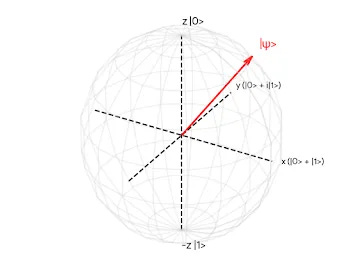
Mathematically speaking, a qubit is undoubtedly richer—it contains infinitely more possible states than a bit. But this richness brings a fatal limitation: a qubit is non-transferable as a qubit. We cannot take an arbitrary quantum state and copy it onto another system without altering the original in the process. This is not a technical deficiency of our devices, but a fundamental property of quantum mechanics.
Imagine holding a book that you cannot read without it changing in the process. The moment you look at the first page, the words on it rearrange themselves. If you want to show the book to a friend, a different version appears to him than to you. This is the world of quantum information—unique, unrepeatable, and, crucially, non-transferable.
How, then, do we arrive at information that we can share? Here enters the process physicists call the collapse of the wave function or, more neutrally, quantum measurement. When a quantum particle—say, a photon or an electron—collides with a macroscopic detector, something specific happens: from a continuum of possibilities (the qubit can point in any direction on the Bloch sphere) we obtain a discrete result (the detector indicates “yes” or “no”, a dot appears here or there).
The physical state has passed from a regime where it cannot be copied into a regime where copying is not only possible but trivial—the measurement result can be written in a notebook, photographed, sent via email, stored in an archive. This transition is a functional transformation: from a “single-use answer” we obtain a “multi-use answer.” From a private state, we obtain a public state. From the incommunicable, we obtain the communicable.
The Nature of Quantum Information
But every translation has its price. When we translate a poem from French to Slovenian, we gain something (understanding), but we also lose something (the sonority of the original, wordplay, cultural references). Something similar happens with the transition from the quantum to the classical world.
Imagine someone asks you: “In which direction is this qubit pointing?” The qubit might be pointing at an angle of 37.4° relative to the north pole. But a classical detector does not know how to measure “37.4°”—it only knows how to answer “up” or “down”. The rich quantum state must be compressed into one of two possibilities. In doing so, we necessarily lose information—that unique, specific angle of 37.4° is irretrievably lost.
And here is the crucial point: this loss is not a flaw in our technology, but an unavoidable consequence of the very demand for transferability. If we want information that we can read multiple times, copy, and share, we must accept that it will be discrete and robust—therefore smaller than the full quantum reality.
The randomness that appears during measurement—whether the detector will show “up” or “down” for a qubit at 37.4°—is a statistical consequence of mapping the continuum into discrete categories. When we force a multidimensional space of possibilities into a binary decision, randomness must occur. Physics strictly determines this: for a qubit at 37.4°, the probability for “up” is, say, 65%, and for “down” 35%. Which of these two results we obtain in an individual measurement is random, but long-term statistics precisely follow these probabilities.
It might seem that the solution is simple: why not simply measure the qubit very precisely so that we do not change it in the process? Why not use more sensitive instruments that could look at the quantum state in detail without disturbing it?
The answer is clear: this is not possible. Every physical process that would extract classical information (that is, information we can copy) from a quantum state must necessarily alter that state. This is a limitation of the very nature of information. Transferability, or the ability to copy, and quantum superposition are mutually exclusive. This is precisely why in quantum cryptography an eavesdropper is always detected: if someone attempts to copy a quantum-encrypted message, they must perform a measurement that necessarily changes the original states and thereby leaves traces.
Reality Beyond Information
At this point, the reader might ask: if the transition to classical information is necessary, and if in doing so we necessarily lose the original quantum state, how do we even know that that primal and elusive level of reality exists? Is this not merely a mathematical fiction, an elegant formalism without physical substance? How can we be certain that the world is not composed only of the bits we see, and that qubits are not merely a theoretical construct?
Experiments offer us the answer. One of the most beautiful and simultaneously most intriguing is the double-slit experiment. When we send individual particles—photons or electrons—through two slits, but do not detect which slit they went through, they do not accumulate on the screen in two piles behind each slit, as we would expect from tiny marbles. Instead, they create an interference pattern of bright and dark bands, which is characteristic of waves. Each electron contributes a single dot, but when we send thousands of them, these dots arrange themselves into a wave pattern.
This interference pattern is key. It tells us that an individual particle—a single electron sent through the apparatus—in some way “knows” about both slits simultaneously. If we close one slit, the interference disappears. If both slits are open but we do not measure which one the particle went through, we obtain a wave pattern. However, if we place detectors that “observe” the particle’s path, the interference is lost and we get two piles. It is as if the particle, the moment we began to observe it, “decided” to be a classical marble.
How are we to understand this? The standard explanation is that when we do not observe the particle—that is, when we do not convert information about its path into a classical form—it behaves as a wave function, as a cloud of probability traveling through both slits simultaneously. This wave function is not merely a mathematical tool for calculating probabilities. It is a physically real state that produces observable consequences in the form of an interference pattern. But when we place a detector and obtain classical information (”the particle went through the left slit”), we say that the quantum state collapses: the wave function “collapses” into one of the possible outcome states, and the interference disappears. Regardless of whether we understand the collapse as a real physical process or as an effective descriptive rule, the experimental outcome remains unchanged.
Objective Quantum Reality
The double-slit experiment is a sort of “reflection” of invisible quantum reality. It tells us that there exists a level of physical existence that eludes our direct access, yet nevertheless unequivocally manifests itself in empirical consequences. This level is not metaphysical speculation or mathematical fantasy, but is necessarily presupposed by experimental data.
If the world were composed only of classical bits, if particles were always either “here” or “there,” there would be no way to explain the interference pattern. We could say: “The particle goes through the left slit, but somehow ‘senses’ the presence of the right slit.” But this is merely a word game that does not solve the problem. The most consistent way to explain interference is to admit: before measurement, the particle is neither “here” nor “there,” but is in quantum superposition, in a state that has no classical equivalent.
Here, key philosophical questions open up. Does the wave function describe something that is in the world, or merely our knowledge about the world? Is a qubit a real entity, or merely a probabilistic model?
For a long time, the prevailing opinion was that the wave function is merely an epistemological tool, or a way to describe our knowledge. But experiments, such as Bell’s inequality and its violations, have seriously undermined this position. These experiments show that if the wave function truly represents only our knowledge of pre-existing properties (hidden variable theories), then these properties must be transmitted faster than light, which contradicts the theory of relativity. Most physicists therefore take the wave function as a description of an objective physical state.
However, this “objective physical state” is not a state in the classical sense. An electron in superposition is not an electron that is somewhere, with us simply not knowing where. The electron is in a state that corresponds to no classical location. This is the essence of quantum weirdness: the world allows for physical states that resist the classical ontology of “objects with properties.”
What is the Reality of a Qubit?
From the perspective of information theory, we can formulate this as follows: qubits are real, but they are not transferable. They exist as physical states inscribed in matter (electron spin, photon polarization), but we cannot “read” them and send them forward without changing them. They are like secret documents written in ink that vanishes upon touch. We know they exist, we see the consequences of their existence, but we cannot copy them.
Bits, as the basis of classical information, are on the other hand real and transferable. They are that type of physical state which survives copying. And since knowledge depends on copying information, bits are practically the only type of states upon which we can build stable shared knowledge.
This does not mean that qubits are less real than bits. It only means that they serve a different purpose. Qubits are what is; bits are what we can say. Reality is full and rich at the level of qubits, but we cannot transfer this fullness forward. To be able to speak of it at all, we must translate it into bits.
This explanation allows us to avoid two extremes. On the one hand, we do not say that quantum reality is “incomplete” or “indeterminate.” A qubit at 37.4° is perfectly determined, for it is precisely in this state and not in another. Randomness enters only at the translation into a bit, not in the qubit itself.
On the other hand, we also do not advocate naive realism, that “particles possess determinate properties all along, only we do not know them.” Bell’s inequalities close off this possibility. The truth is more subtle: particles have determinate quantum states (qubits do not need to be “created” only upon measurement), but these states do not correspond to classical categories of “properties.” They exist, but they are not transferable.
Žižek’s Understanding of Quantum Physics
In his work Quantum History: A New Materialist Philosophy (Bloomsbury Academic, 2025), Slavoj Žižek defends the thesis that quantum physics should not be read merely as an epistemological limitation of our knowledge, but as a direct insight into the ontological structure of reality itself. While classical science and traditional materialism assume that the world “out there” exists as a solid, fully determined mechanism of atoms in empty space, Žižek rejects this image. For him, the essence of the quantum revolution does not lie in the realization that our measurement is incomplete and that we cannot know everything, but in the fact that reality itself does not know everything about itself. Indeterminacy is not a consequence of our ignorance regarding hidden data, but a consequence of the fact that these data do not ontologically exist. A crack gapes in the very structure of being; the world is not a closed whole, but is fundamentally “holey,” inconsistent, and unfinished.
Žižek grounds this “ontology of lack” in a sharp rejection of the idea of “hidden variables.” Einstein’s assumption that behind quantum chaos there must exist some hidden, deterministic order which we have merely not yet discovered is, for Žižek (and most of modern physics), erroneous. However, Žižek draws a philosophical conclusion from this physical rejection: if there are no hidden variables that would predetermine the properties of a particle, this means that measurement does not discover the state, but literally produces it. The collapse of the wave function is not a transition from ignorance to knowledge, but a moment when indeterminate, floating reality “collapses” into determinacy. For Žižek, this process is retroactive: the present intervention (measurement) determines not only the present but retroactively establishes the conditions and history that led to this outcome. This is the core of his “new materialism”: matter is not inert substance, but an open process that is constituted in the act.
To bring this abstract idea closer to the reader, Žižek employs the vivid metaphor of “God as a lazy programmer.” He compares the universe to modern video games where the computer, to save processing power, does not render the entire world at once, but renders the interior of a house or a landscape only in that split second when the player enters it or looks in that direction. For Žižek, our reality is exactly like this: ontologically economical. Trees, atoms, and stars do not exist as determinate facts in the full sense of the word until an interaction occurs that forces them into existence. Reality is therefore not a full, dense substance, but a potentiality waiting for actualization.
From this fundamental indeterminacy, Žižek also derives the concept of the hologram or the perspectival whole. Since reality is not the “All,” we can never capture it from a neutral “God’s-eye view from nowhere.” Every attempt to grasp the whole necessarily occurs from a specific, biased position. Every era, every subject, and every discourse creates its own “hologram”—an image of the whole that is valid only within its own horizon and is inextricably linked to the point of view. Hereby, Žižek radicalizes Heidegger’s insight regarding the historical mediation of truth: it is not merely that we see the world differently, but that its truth changes depending on how we intervene in it. Subjectivity in this system is no longer an external observer disturbing the objective world, but is a necessary “error” or gap through which reality is properly constituted.
Relational Quantum Mechanics and Retroactivity
Žižek further grounds his ontology of lack by referring to Carlo Rovelli’s Relational Quantum Mechanics. According to this interpretation, physical objects, such as electrons or photons, do not possess properties “in themselves” or in isolation. Properties such as spin, position, or velocity are established exclusively in interaction with another system. An electron does not have a spin until it collides with a measuring device or another particle; its spin is always spin relative to something else. Thus, there is no neutral state of the world prior to interaction, but only a web of relations.
For Žižek, this physical theory is an ideal confirmation of his philosophical system. If properties emerge only in relations, then the classical metaphysical notion of a solid, substantial world “out there” waiting to be discovered falls away. Reality is not a collection of independent substances, but a dynamic network of interactions without a central core. And since these interactions are always local, partial, and perspectival, reality itself is necessarily incomplete. It never assembles into a whole, as this would require a “view from nowhere,” which the relational nature of the universe forbids.
From this relational and indeterminate nature of the world, Žižek derives the idea of the retroactive constitution of reality. He argues that the collapse of the wave function does not operate only in the present but reaches back into time. When we measure the spin of an electron and obtain a determinate value, this result retroactively constitutes the past, as if the electron “always already” possessed this value, even though it was in an indeterminate superposition prior to measurement. The measurement, therefore, does not discover a past fact, but creates it retroactively. Thereby, the past proves to be open and changeable, rather than a fixed archive of events.
Žižek rests this seemingly speculative idea on the interpretation of physical delayed-choice experiments, where the observer’s decision in the present (how to set the apparatus) influences how the particle behaved in the past (whether it traveled as a wave or as a particle). For Žižek, this is the crowning proof that time is not a linear arrow flying from the past toward the future, but a dialectical loop in which the present constitutes its own origin. He then directly transfers this logic to the understanding of history and society: historical events are not simple consequences of past causes. A groundbreaking event, such as a revolution, does not only change the future but “rewrites” the meaning of the past, so that what previously appeared as contingency retroactively becomes the necessity that led to the new state.
Relational Quantum Mechanics Is Not an Ontology of Lack
However, when Rovelli argues that an electron possesses no determinate spin “in itself,” he does not mean that the electron is ontologically empty, holey, or incomplete. He means only that spin—like the majority of physical quantities—is a relational category. This is most easily understood through a comparison with the theory of relativity: the velocity of a body is never an absolute property that the body would possess independently of an observer. My velocity is 0 km/h relative to the chair I sit on, and 100,000 km/h relative to the Sun. This does not mean that my velocity “does not exist” or that I am ontologically “incomplete.” It means only that velocity is a type of property that is established only in a relation. The electron has a precisely determined spin relative to a specific reference system of measurement. In this relation, there are no “holes.”
Žižek’s error lies in equating relationality with incompleteness. From the fact that properties are not absolute (independent of context), he infers that reality is not determined. Yet a relational property can be—and in physics, is—fully determined and real. The fact that the same electron appears with a different spin if we change the axis of measurement (the reference system) is not proof of a lack in reality, but proof of the richness of its relational potentials. A relational property is simply not a property of the object “in itself,” but a property of the pair “object–reference system.”
Similarly problematic is Žižek’s fascination with delayed-choice experiments, upon which he builds his thesis of the retroactive constitution of the past. Because our decision today regarding the method of measurement influences the results we interpret as the past behavior of the particle, Žižek concludes that the present literally creates the past. But there exists a less dramatic and more physical explanation that avoids the idea that we intervene back into time. In this light, these experiments do not show a changing of the past, but rather reveal that quantum correlation is not localized in time in the manner of classical causality.
The wave function is a comprehensive mathematical object describing all possible correlations between events in time. When we choose today how we will measure the system, we thereby only choose which of the already existing correlations we will actualize. It is not a matter of rewriting history retroactively, but of selecting a certain cross-section from the entire quantum history of the system (which is consistent throughout). The wave function remains the same; we merely determine the “optics” through which we view it. While there are authors who advocate retrocausal readings where it makes sense to speak of the influence of the present on the past, I adopt a more conservative stance here: the wave function as a complete description of correlations is consistent at all times, and with measurement, we select which aspect of this whole we will actualize.
Here we arrive at the key point Žižek overlooks in his search for philosophical meanings. Although he refers to interactions, he forgets that interaction in physics is not merely an abstract logical relation, but a concrete physical process that has its price. When we say that measurement “collapses” a quantum state into a classical one, a change does not occur merely in our knowledge. A thermodynamic process takes place. Information encoded in a non-clonable qubit must be rewritten into bits—into a robust form that can be copied and stored. This process of rewriting is irreversible and requires energy. Žižek’s “ontological hole” is in reality merely the site of this energetic and informational translation.
Materialism of the 21st century therefore does not need the mysticism of “holes in being.” The world is consistent both at the level of qubits and at the level of bits. The quantum state (qubit) is mathematically precise and physically real, just as classical information is real. The problem arises only at the transition. We cannot directly transfer or share quantum reality because we cannot copy it. To speak of it at all, we must translate it into bits. This translation is necessarily a reduction, but this reduction is not an ontological loss of substance, but an epistemological necessity of communication. The randomness that appears in this process is not proof that reality is missing something. Randomness is the tax we pay for conversion; it is the price for importing data from the quantum to the classical world. This is not a glitch in the system of reality, but a structural property of information itself: a qubit cannot pass into a bit without payment, and the currency of this payment is randomness.
A Critique of Ontological Incompleteness
Žižek’s interpretation of quantum mechanics is philosophically extremely seductive, but it stands or falls on a single, yet risky inference: from the fact that we cannot directly observe quantum states as classical objects (that is, as bits), Žižek infers that these states in themselves are not fully determined. From an epistemological limitation of our access, he derives an ontological thesis about the very nature of the world. The key question, however, is whether this leap is justified, or if it is perhaps a subtle category mistake in which we judge the quantum world by criteria that do not apply to it.
Let us look at Heisenberg’s uncertainty principle, which is for Žižek one of the foundations of his ontology of lack. The standard formulation states that we cannot simultaneously know precisely the position and momentum of a particle. The more precisely we measure one, the more the other eludes us. But what does this mean for reality? Žižek reads this literally: the particle “does not have” a precise position and velocity because reality has not bestowed these properties upon it. However, there exists a different, more consistent explanation: the particle is in a quantum state that is simply not of the same ontological type as a classical point. When we ask for “exact position and velocity,” we are asking for properties of a classical bit, whereas the particle is a qubit or a wave function.
We can understand this most easily with a simple analogy. Imagine a wave on the sea. If you ask: “Where exactly is this wave?”, the question is nonsensical. A wave is not a point; it is a dispersed phenomenon covering a certain area, having a wavelength and amplitude. We can determine its center, but there is no “point” that is the wave. Does this mean the wave is “incomplete”? Does this mean the wave “does not yet know where it is”? By no means. It only means that the wave is by its nature a dispersed entity for which the category of point location is not appropriate. It is similar with a quantum state: a qubit in superposition is not “undecided between two possibilities,” but is in a third, fully real state, which however has no classical equivalent. If we look at a qubit in a state of perfect superposition (mathematically written as the vector ∣ψ⟩ = (1/√2)|0⟩ + (1/√2)|1⟩), we see that this state is, from a mathematical standpoint, fully determined. The vector is precisely specified, its length is one, its direction in Hilbert space is fixed. It lacks nothing. There is no “hidden parameter” that God forgot to define. The state is clear. (Such an understanding of the wave function is indeed predominant today, but not the only position in interpretive debates on quantum mechanics.)
At this point, Žižek could object that the mathematical completeness of the formalism does not yet guarantee the ontological completeness of reality. The wave function might be merely a computational tool with which we predict probabilities—not a description of what is. But this objection neglects the physical reasons for which the majority of modern physicists take the wave function more seriously. Bell’s inequalities and their experimental violations show that if the wave function were merely a reflection of our ignorance of pre-existing properties (as Einstein would have wanted), these hidden properties would have to influence one another faster than light. Since we do not accept this, we must accept that the wave function is not merely a measure of our ignorance, but a description of something real—a state that, prior to measurement, is simply not classical. The mathematical completeness of the wave function is therefore not merely formal elegance, but a consequence of the fact that it describes a physical reality which is determined, but not in a classical way.
The Essence of Quantum Materialism
The central dilemma of modern materialism reads thus: does quantum physics truly demand that we understand reality as ontologically incomplete, cracked, and fundamentally unfinished? Žižek’s project is, in this regard, undoubtedly a fascinating attempt at the materialization of incompleteness itself. In a desire to save materialism from naive realism—from the notion of the world as a solid, predetermined mechanism—Žižek proposes a bold turn: matter itself is constitutively unfinished. For him, indeterminacy is not an epistemological obstacle, but a positive property of being. However, we must ask whether this interpretation might be too precipitous and whether the physics of information offers us a different, more operative lesson.
There exists, in fact, an alternative path that remains faithful to the idea of an independent reality while simultaneously taking the paradoxes of quantum mechanics seriously. This “information materialism” does not seek holes in reality, but recognizes a fundamental structural difference between two regimes of physical existence: between those states that are transferable and stable (bits), and those that are unique and unrepeatable (qubits). In this light, Žižek’s “ontological crack” is no longer a name for a lack in reality, but for the necessary friction that arises when we attempt to translate the rich, vector nature of the quantum world (the qubit) into the binary language of our macroscopic experience (the bit). The difference lies not in the fact that reality is missing something, but in the fact that it is simply too complex for our classical categories.
It is crucial to understand that a qubit—this condensed essence of quantum information—is something fully real and determined. An electron in superposition does not float in some hazy indeterminacy, but resides in a precisely defined physical state described by a wave function. That we cannot copy this state without destroying it (the No-Cloning Theorem) is not proof of its incompleteness, but proof of its substantial autonomy. The problem with Žižek’s interpretation is that he tacitly attributes the status of “true” reality only to that which is fixed and determined. When he encounters a state that eludes this, he declares it holey, instead of recognizing in it a different form of materiality.
Here we collide with the inescapable fact of the materiality of information itself. Information is not an ethereal thought floating in an abstract space; information is necessarily inscribed in matter and linked to energy. Without a material carrier, there is no information. On this point, we agree with Žižek: there is no neutral “God’s-eye view from nowhere” that could capture the world as a whole without intervening in it. But the reason for this lies not in the world being ontologically crippled, but in the fact that every act of knowing is a physical process. If we want knowledge that can be shared, copied, and socially transmitted—if we want to cross from the privacy of the quantum to the publicity of the classical—we must accept the necessity of translation or measurement.
We can conclude that quantum indeterminacy does not testify to nature failing in its own realization. On the contrary, it testifies to the fact that our access to reality is conditional upon the physical price of stability. Randomness is not the signature of a lack in nature, but the trace of that surplus of reality which refuses to be fully digitized. Freedom is thus not necessarily a property of a “holey” universe, but primarily a property of beings who build their understanding in the language of communication, which is necessarily in the form of classical information that can be copied, stored, and transmitted.
Translated from the Slovene original, available here:

For more information, see also the article:
Paradoxes of Reality: What Quantum Mechanics Really Tells Us About the World

Quantum mechanics works very well. Its predictions are remarkably precise, and a large part of modern advanced technology is based on it. In the century since its inception, it has established itself as one of the most successful theories in the history of science.